When Should You Use 4-Axis CNC Machining for Complex Parts?
If your production line involves multi-sided components, angled bore features, or curved surfaces that keep requiring repeated fixture changes, 4-axis machining parts may be exactly what your engineering team needs. The short answer: use 4-axis CNC machining when your part geometry demands processing on more than two faces, when repositioning errors are causing batch scrap, or when you need to cut cycle time and per-unit cost on medium-volume runs between 100 and 10,000 pieces. At BOEN Rapid, we've seen this method reduce setup counts by up to 60% and lower manufacturing costs by 25–35% compared to conventional 3-axis workflows.
Understanding 4-Axis CNC Machining: Definition and Capabilities
What the Fourth Axis Actually Does
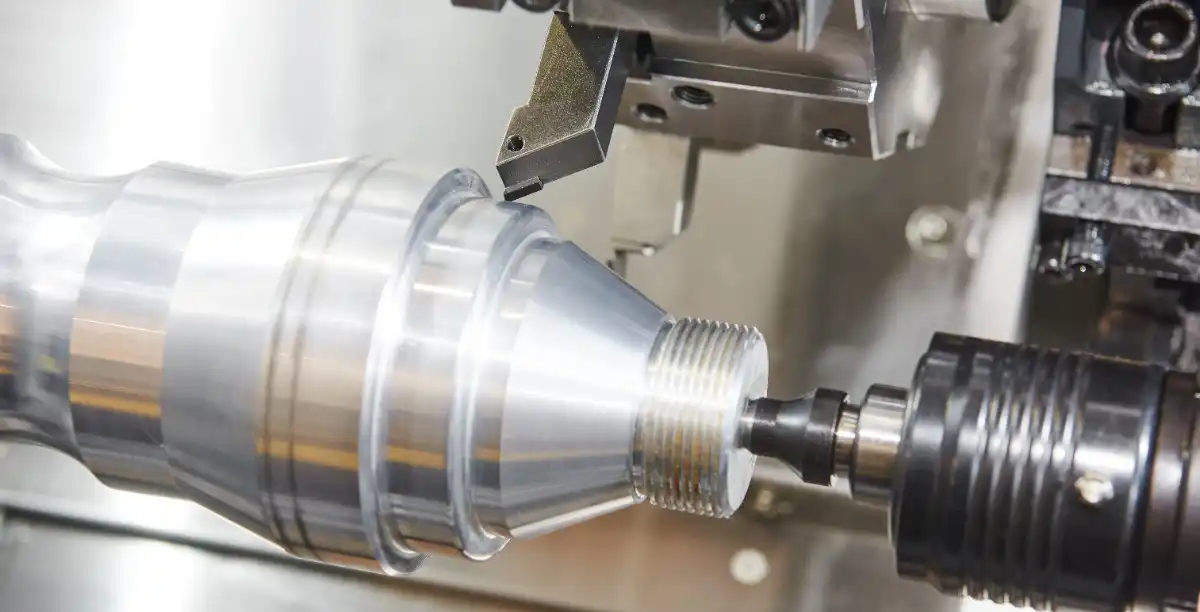
Standard CNC machines with three axes move in straight lines along X, Y, and Z. A 4-axis system adds an A or B axis that can rotate, which lets the workpiece keep turning while it is being cut. This means that features like angled holes, helical grooves, and radial slots can be machined on more than one face without having to unclamp the part. As a result, geometries that used to need four to six separate operations can now be solved with just one setup.
Materials and Tolerance Range
The rotary axis doesn't limit the kinds of materials that can be used. Our 4-axis CNC systems at BOEN Rapid can work with aluminum metals (6061 and 7075), stainless steel 303/316, titanium Ti-6Al-4V, and industrial plastics like PEEK, ABS, and Nylon. Depending on the shape, the tolerance ranges from ±0.005mm to ±0.05mm, and surface finishes can be made from Ra 0.4µm to Ra 3.2µm. Our standard size for parts is up to 600 mm x 400 mm x 300 mm.
Typical Components Produced
The method works for many different kinds of precise parts. Rotary-axis machining is useful for making actuator housings for robots, sensor mount brackets with compound angles, gearbox housings for cars, and parts for orthopedic implants. Parts like aerospace-grade turbine clamps and medical surgery tool handles—where exact measurements affect how well the assembly works—are often made.
When to Choose 4-Axis Machining Over 3-Axis or Other Methods
Where 3-Axis Falls Short
4-axis machining parts with flat faces and angular shapes work well with 4-axis machining. When a plan calls for angled parts, undercuts, or multiple faces, the 3-axis method needs more than one fixture setup. Every time you move something, you add to the alignment error. For a batch of 500 pieces, even a shift of 0.02 mm per setup can lead to a lot of waste and high rework costs that quickly eat away at the profit margin.
The Cost and Speed Case for 4-Axis
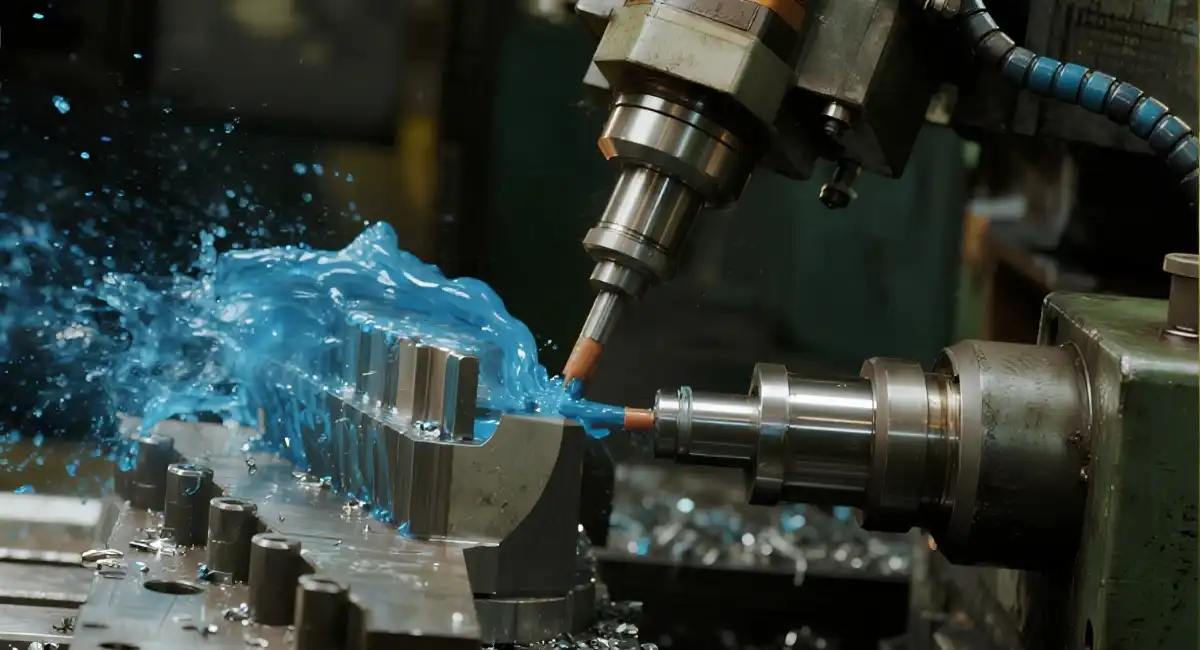
Independent research in manufacturing engineering shows that combining setups cuts down on non-cutting time, which is a big part of the total cost of a part. The Society of Manufacturing Engineers says that setting up and moving parts can take 30 to 50 percent of the total time needed to machine complex parts. When working with similar shapes, 4-axis milling cuts cycle times by 40–50% by cutting the number of setups from four to one or two. This directly makes lead times more predictable for OEM buyers who manage quarterly production schedules.
When 5-Axis Is the Better Choice
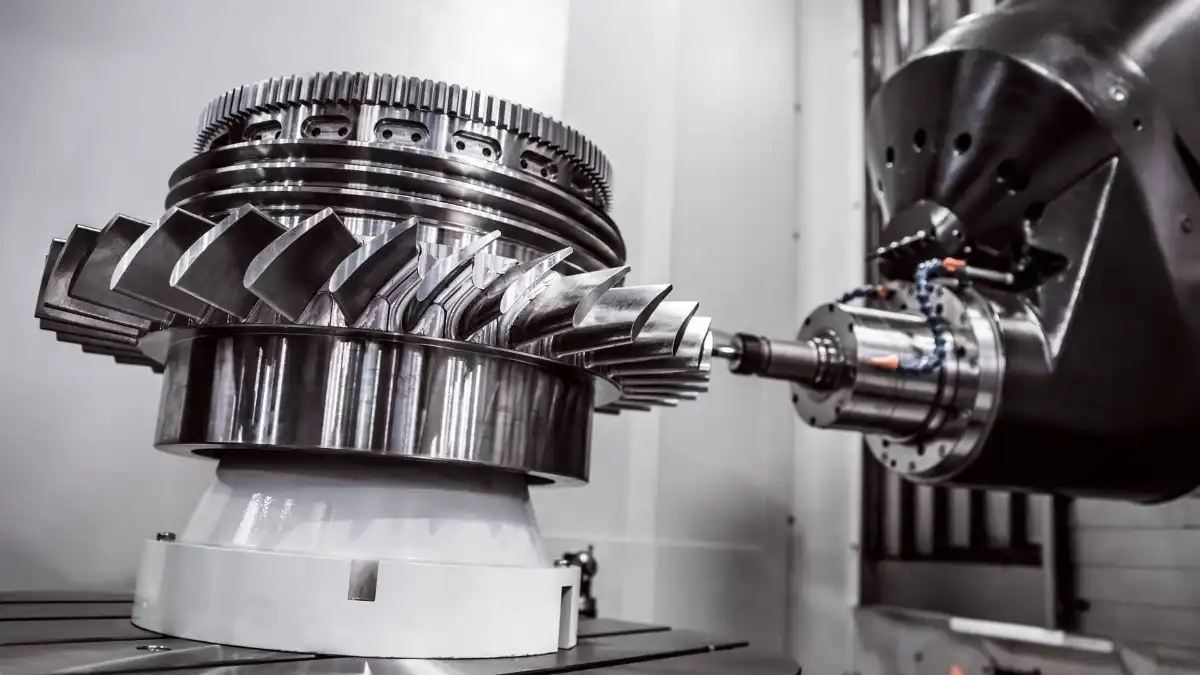
Four-axis cutting is a good way to handle most needs for multi-face and curved features. But 5-axis machining is needed when a part needs to be shaped at the same time in five directions or has features with compound curves, like airfoils on turbine blades. For many robotics, automation, and Tier 2 automotive parts, 4-axis capability is enough to cover the geometry without the extra cost of programming and fixturing for 5 axes.
Industry Applications and Typical Use Cases of 4-Axis Machining
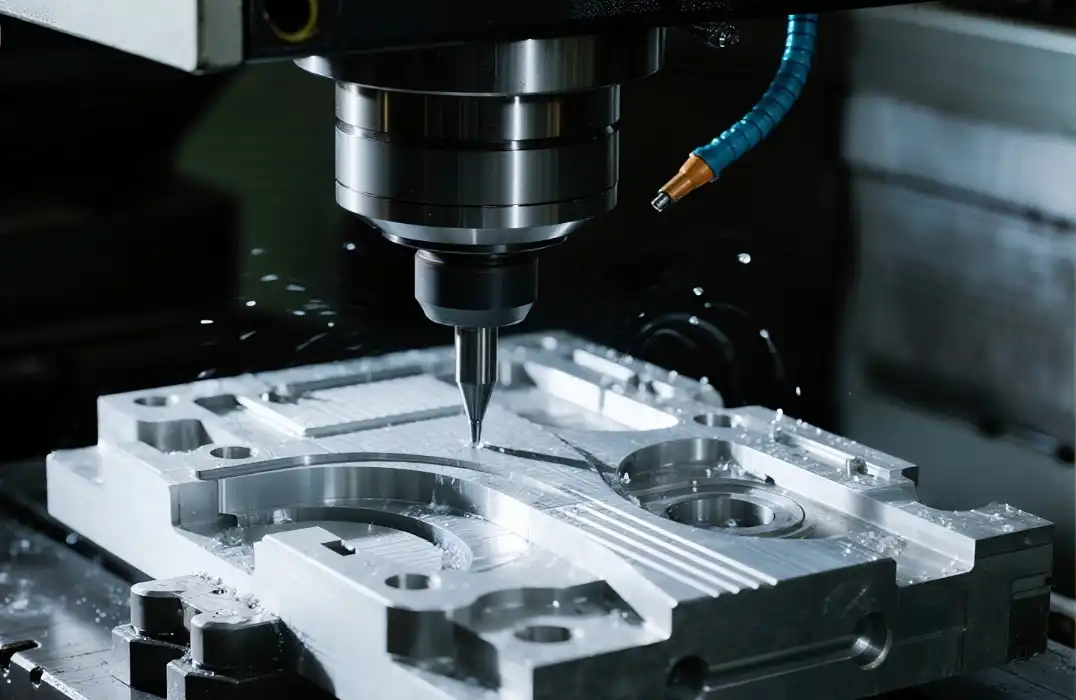
Four-axis CNC is useful in industries that need to meet tight tolerances and multiple face features at high output rates. Here are four areas of use where this method regularly gives usable results:
- Robotics and Automation Components: Gripper assemblies, end-effector mounts, and joint housings frequently carry angled attachment faces and radial bore patterns. Machining these features in a single setup maintains positional accuracy between surfaces, which directly affects robot calibration and repeatability. Weight reduction through aluminum selection is also achievable without sacrificing geometric precision.
- Automotive Tier 2 Parts: Engine brackets, transmission housings, and sensor carrier plates often carry compound drilling patterns. 4-axis machining allows all radial and angular holes to reference a single datum, reducing positional deviation between features. CMM reports generated after each production batch document conformance to drawing specifications.
- Medical Device Components: Surgical instrument handles, implant trial components, and diagnostic housing parts require biocompatible materials and micron-level accuracy. BOEN Rapid's ISO 13485-certified process covers titanium and PEEK machining with full material traceability, meeting FDA and CE documentation requirements.
- Aerospace Structural Parts: Mounting brackets, hydraulic manifold blocks, and sensor housings with compound-angle interfaces benefit from 4-axis rotary processing. Aluminum 7075 and titanium Ti-6Al-4V are standard materials in this context, and our process maintains aerospace-grade tolerances throughout batch production.
These areas of use all have to deal with the same production problem: making parts with multiple faces that are of the same quality across medium batch sizes. All of these problems can be solved by 4-axis cutting in a single production cell.
How to Procure Quality 4-Axis CNC Machining Services
Supplier Qualifications to Verify
Before you place a trial order, make sure the supplier is currently certified with ISO 9001 and, if your parts will be used in medical or regulated assemblies, ISO 13485. Ask for examples of CMM inspection reports from the last few production runs. For automotive programs, a good 4-Axis machining parts supplier should offer First Article Inspection (FAI) paperwork and PPAP support. BOEN Rapid is certified by both ISO 9001 and ISO 13485, and on medium-volume orders, CMM reports are included as standard.
Pricing Structure and Lead-Time Expectations
The cost of 4-axis CNC parts depends on the type of material used, how complicated the geometry is, the batch size, and the level of finish needed on the surface. Because code and setup costs are spread out over fewer parts, prototype numbers usually have higher per-unit costs. The cost per unit goes down a lot as the batch size goes from 100 to 10,000 units. It takes BOEN Rapid 3–15 working days to send test parts and 2–4 weeks to finish low-volume production runs. For projects with tight deadlines, you can get a sample quickly—within 3–5 business days.
Evaluating Batch Consistency
Batch-to-batch consistency is one of the most important quality issues for procurement teams that run OEM/ODM programs. Ask any potential provider for CPK statistics or written records of their process capabilities. If the Cpk number is above 1.33, it means that the method keeps tolerances consistently across production runs. Our production engineering team at BOEN Rapid uses our quality control system to keep track of dimensional data. If you ask, we can also give you inspection records for each batch.
Conclusion
4-axis machining parts are a direct solution to the issue of multi-face geometry on a large scale.
FAQ
1. What materials can be machined using 4-axis CNC equipment?
4-axis CNC systems machine a broad range of metals and engineering plastics. Common metals include aluminum alloys (6061, 7075), stainless steel 303 and 316, carbon steel, and titanium Ti-6Al-4V. Engineering plastics such as PEEK, ABS, Nylon, and Delrin are also compatible. Material selection depends on the application's mechanical, thermal, and regulatory requirements.
2. How does the rotary axis improve dimensional accuracy?
By keeping the workpiece clamped in one position throughout all cutting operations, the rotary axis eliminates the repositioning errors that accumulate in multi-setup 3-axis workflows. All machined surfaces share a single datum reference, which produces tighter geometric relationships between features and reduces inspection rejection rates on assembled components.
3. When does a part require 5-axis machining instead of 4-axis?
5-axis machining becomes necessary when a part requires simultaneous contouring across five planes or features with complex compound curvature — for example, turbine blade airfoils or impeller vanes. For the majority of robotics, automation, and automotive components with angled holes, multi-face profiles, or radial slot patterns, 4-axis capability is sufficient and more cost-effective.
4. What batch sizes are practical for 4-axis CNC production?
4-axis CNC production scales from single prototypes to 10,000+ unit production runs. The method is particularly cost-efficient for medium-volume batches between 100 and 5,000 pieces, where setup cost amortization balances favorably against per-unit machining time.
5. Does BOEN Rapid provide CMM inspection reports with orders?
Yes. BOEN Rapid provides CMM dimensional verification reports as standard on medium-volume orders. Material certificates, surface roughness test records, and First Article Inspection documentation are available upon request.
Request a 4-Axis Machining Quote from BOEN Rapid
CNC devices with 4-axis machining can cut a lot of different metals and industrial plastics. Aluminum alloys (6061 and 7075), carbon steel, stainless steel 303 and 316, and titanium Ti-6Al-4V are all common metals. It's also possible to use engineering plastics like PEEK, ABS, Nylon, 4-axis machining parts, and Delrin. The choice of material is based on the mechanical, thermal, and legal needs of the product. To get a price right away, email your images to contact@boenrapid.com.
References
1. Society of Manufacturing Engineers. Tool and Manufacturing Engineers Handbook: Machining. SME, 2018.
2. Kalpakjian, S., & Schmid, S. Manufacturing Engineering and Technology. Pearson Education, 2014.
3. Modern Machine Shop. CNC Machining Technology and Applications Annual Report. Gardner Business Media, 2022.
4. International Journal of Advanced Manufacturing Technology. Effect of Multi-Axis Machining on Dimensional Accuracy of Complex Components. Springer, 2021.
5. American Machinist. Setup Reduction Strategies in Precision CNC Production. Endeavor Business Media, 2020.
6. Quality Progress. Process Capability and Statistical Control in CNC Manufacturing. ASQ, 2019.